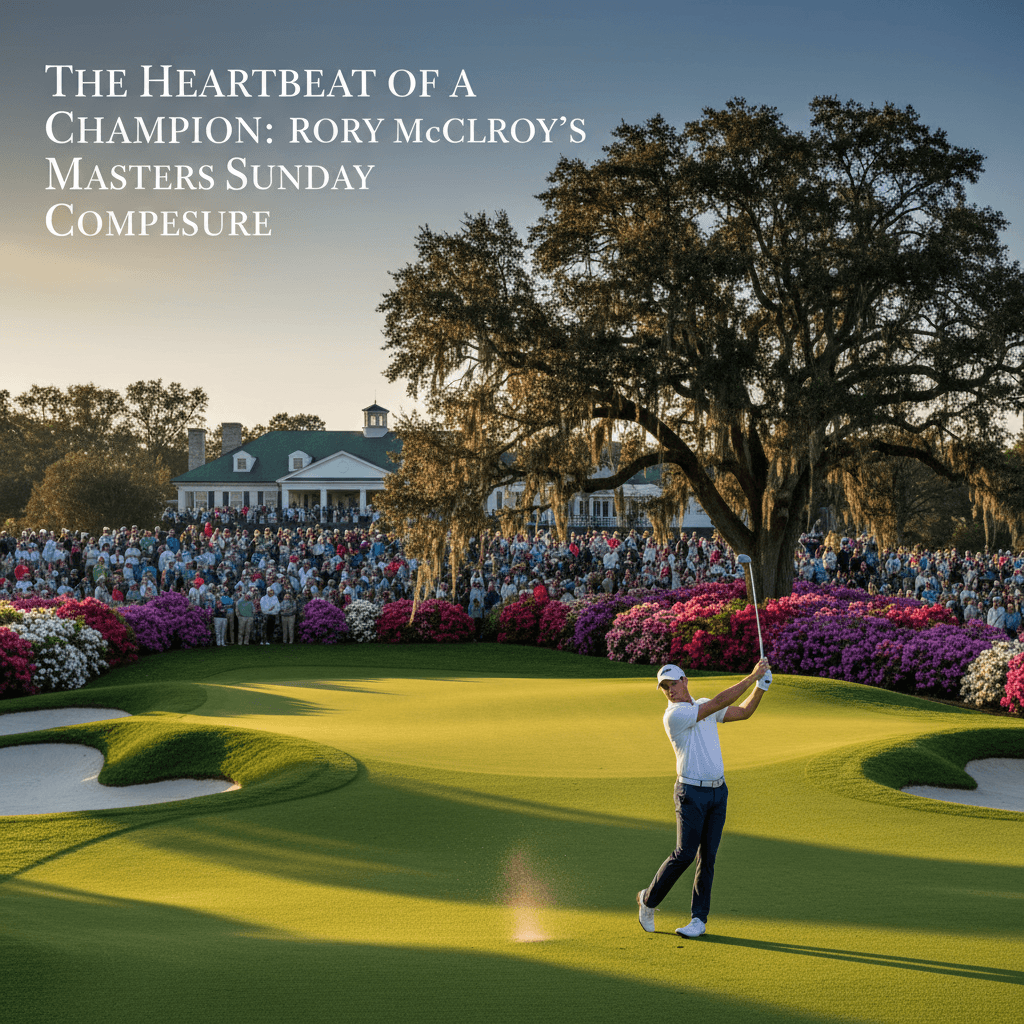
The Heartbeat of a Champion: Inside Rory McIlroy's Masters Sunday Composure
I've stood on countless championship tees, felt the air thicken with expectation, watched players' hands tremble as they reached for their drivers. But I've never had a window into what actually happens inside a golfer's chest during those moments—until now.
Whoop, the wearable fitness tracker that Rory McIlroy has endorsed and relied upon, released his physiological data from the final round of the 2026 Masters. And what it reveals is perhaps the most compelling evidence yet of why McIlroy finally conquered Augusta's Sunday demons: he has learned, quite literally, to slow his heart when everything screams at him to speed up.
The Moment Everything Could Have Unraveled
Picture the 18th hole on Masters Sunday. Two-shot lead. The green jacket within reach. And then—the drive leaks right, into the trees. We've seen this story before at Augusta, and it rarely ends well.
McIlroy's resting heart rate typically sits between 47 and 49 beats per minute, a testament to his elite cardiovascular conditioning. After that wayward tee shot, his heart rate spiked to 135 BPM. This is entirely normal—adrenaline flooding the system, the body's ancient fight-or-flight response activating precisely when modern sport demands stillness.
But here's where the data becomes remarkable. By the time McIlroy stepped into his second shot, his heart rate had already dropped to 121 BPM. He was actively regaining control of his physiology in real time.
A Pattern of Deliberate Calm
The approach found the front greenside bunker—hardly ideal, but manageable. His heart rate climbed again to 136 BPM. Once more, he settled himself. Standing over his par putt, McIlroy's heart rate fell to 117 BPM. And that tap-in for victory? His body had already accepted what his mind knew was coming.
This pattern—spike, settle, spike, settle—reveals something profound about McIlroy's evolution as a competitor. In the moments where most players tense, where hands quicken and breath shortens, he has trained himself to move in the opposite direction. He slows down when everything tells him to speed up.
The Foundation: Sleep and Recovery
Composure under pressure doesn't emerge from nothing. McIlroy's Whoop data showed recovery scores that remained consistently high throughout the tournament, reaching 87% on Sunday and peaking at 94% earlier in the week. His body stayed primed, ready to respond.
Sleep—so often dismissed in golf coverage in favor of swing mechanics and putting statistics—gave him a crucial edge. McIlroy logged over 9 hours Saturday night into Sunday, achieving 92% sleep performance. He averaged 8.5 hours across the weekend. His resting heart rate remained steady in that 47-49 BPM range, evidence that elite conditioning and deliberate recovery were paying dividends when they mattered most.
The Workload Behind the Walk
Augusta National is not a gentle stroll. The hills, the distances between greens and tees, the mental strain that manifests as physical fatigue—it accumulates. McIlroy logged more than 24,000 steps on Sunday alone and exceeded 91,000 across all four rounds. His strain score reached 16.8 on Sunday, reflecting sustained effort without tipping into the dangerous territory of fatigue.
I've walked Augusta during Masters week, felt the elevation changes in my calves, understood why players look emptied by Sunday evening. McIlroy's body was working hard, but his preparation ensured he never broke.
What This Means for the Game
There's something beautifully humanizing about this data. We watch these players as if they exist on a different plane—and in many ways, they do. But McIlroy's heart still races when drives find trees. His body still floods with adrenaline when everything hangs in the balance. The difference is what happens next.
Years of experience, of painful Sunday collapses and hard-won lessons, have taught McIlroy how to regain control. He doesn't eliminate the stress response; he manages it. He acknowledges the spike and then deliberately returns to baseline.
Key Takeaways
- McIlroy's heart rate spiked to 135-136 BPM in high-stress moments on 18 but dropped significantly before each subsequent shot
- Recovery scores remained above 87% throughout Sunday, with sleep performance at 92% the night before
- Over 91,000 steps across four rounds demonstrated the physical demands McIlroy's conditioning helped him withstand
- The data suggests McIlroy has developed the ability to consciously regulate his stress response under championship pressure
We may never know exactly what it feels like to stand over a putt to win the Masters. But thanks to the numbers behind the magic, we now understand a little more about what happens inside a champion when the moment arrives—and how Rory McIlroy taught himself to breathe through it.