The Sound and Fury at LIV Mexico: A Tour Defiant Amid Storm Clouds
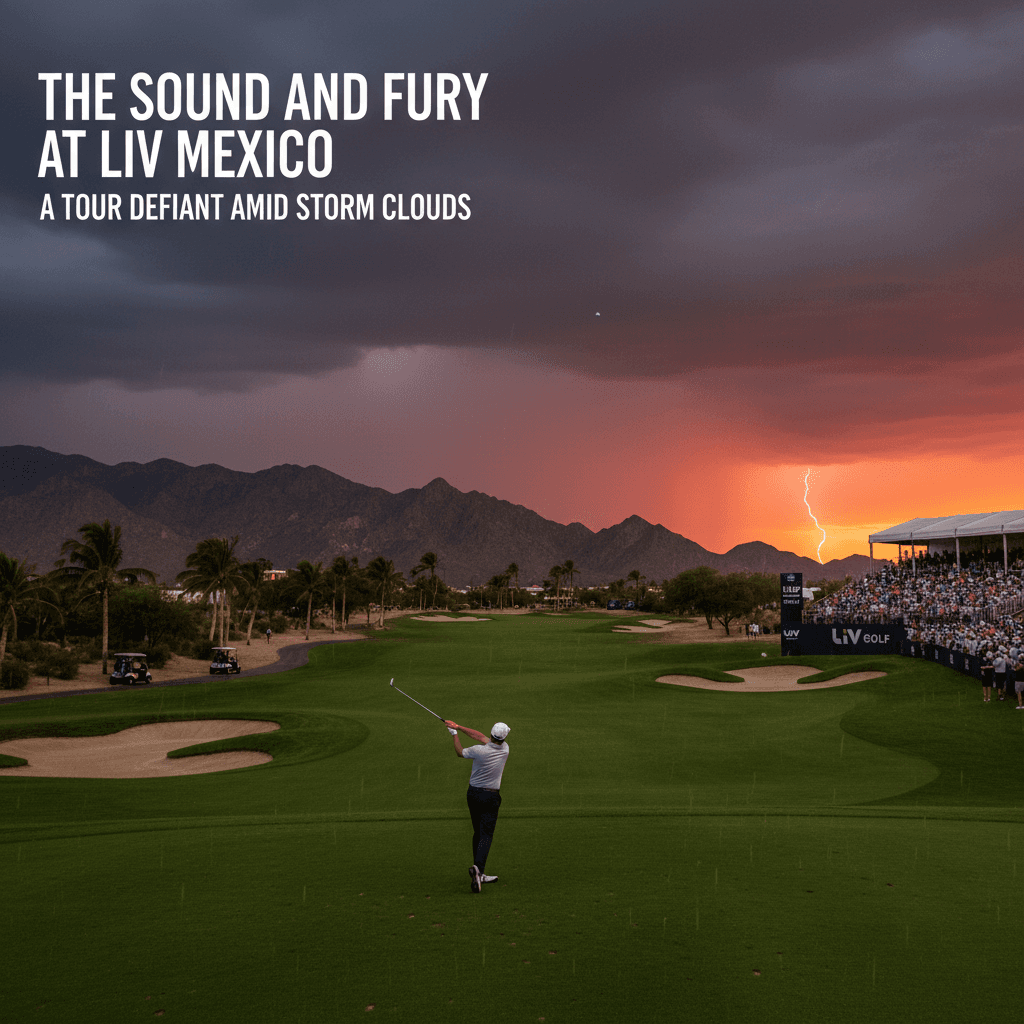
There's a particular quality to tournament days when the stakes extend beyond birdies and bogeys. I've felt it at Ryder Cups, at majors when weather threatens, and now, unmistakably, at LIV Mexico—where the first tee carries the weight of existential questions that no leaderboard can answer.
Defiance in the Desert
The Financial Times reports that Saudi Arabia's Public Investment Fund may be withdrawing its backing from the breakaway circuit. Other publications have followed with similar speculation. And yet, here we are, watching players stripe drives into the Mexican sunshine as if the very ground beneath them isn't shifting.
LIV Golf CEO Scott O'Neil addressed the turbulence directly in an email to staff that found its way to reporters. His language was deliberately combative: "Our season continues exactly as planned, uninterrupted and at full throttle." He called the tour's members "pioneers" and framed the current noise as "the sound of a movement that is working."
It's the kind of corporate bravado that either ages brilliantly or terribly. We won't know which for some time yet.
Sergio Garcia and the Promise of Many Years
Sergio Garcia, the 2017 Masters champion who captains the Fireballs, offered his own reassurance before Thursday's opening round. He referenced a conversation with PIF governor Yasir Al-Rumayyan from earlier this year.
"That is not what Yasir told us at the beginning of the year," Garcia said of the withdrawal speculation. "He told us that he is behind us, that they have a project of many years. There are always rumours."
Players were reportedly told at a previous event that funding is secured through at least 2032. Whether that commitment survives the current "serious review" of PIF investments—a phrase a senior Saudi source used with the BBC in January—remains the central question.
The Numbers Behind the Noise
The financial picture provides context for the concern. LIV's net losses in international markets outside the United States reached $462 million in 2024 alone. Since launching in 2021, the tour has reportedly lost more than $1.1 billion. PIF's total investment is said to be approaching $5 billion, while broadcast rights have generated a remarkably modest $2.7 million.
O'Neil himself acknowledged in February that profitability remains five to ten years away. That's an eternity in the world of sports investment, particularly when the parent fund is under pressure to demonstrate returns and has pivoted attention toward artificial intelligence and technology sectors.
A senior source in European golf told the BBC they believe LIV would not be viable without PIF funding and suggested the tour's leadership may be attempting to find alternative revenue streams. The scramble, if it exists, happens far from the pristine fairways where competition unfolds.
The Atmosphere on the Ground
What strikes me about moments like these is how golf courses become theaters for drama that transcends sport. The players at LIV Mexico made their choices—lucrative ones, controversial ones—and now they perform their craft while the narrative swirls. Some will have contractual protections. Others may be more exposed. All of them must compartmentalize in ways that most of us never will.
The course itself doesn't care about Financial Times headlines or corporate emails. It simply presents its challenges and waits. There's something almost meditative about that indifference, even as the humans walking its fairways carry the burden of uncertainty.
The Takeaway
- LIV Golf's leadership has issued emphatic denials that the tour faces imminent collapse, with CEO Scott O'Neil insisting operations continue "at full throttle."
- Players including Sergio Garcia cite assurances from PIF leadership that funding extends for "many years," reportedly through 2032.
- Financial realities present a challenging picture: over $1.1 billion in losses since 2021, with profitability potentially a decade away.
- The coming months will reveal whether the defiant rhetoric matches the financial commitment—or whether golf's most disruptive experiment faces a reckoning.