The Counterintuitive Secret to Faster Clubhead Speed: Slow Down
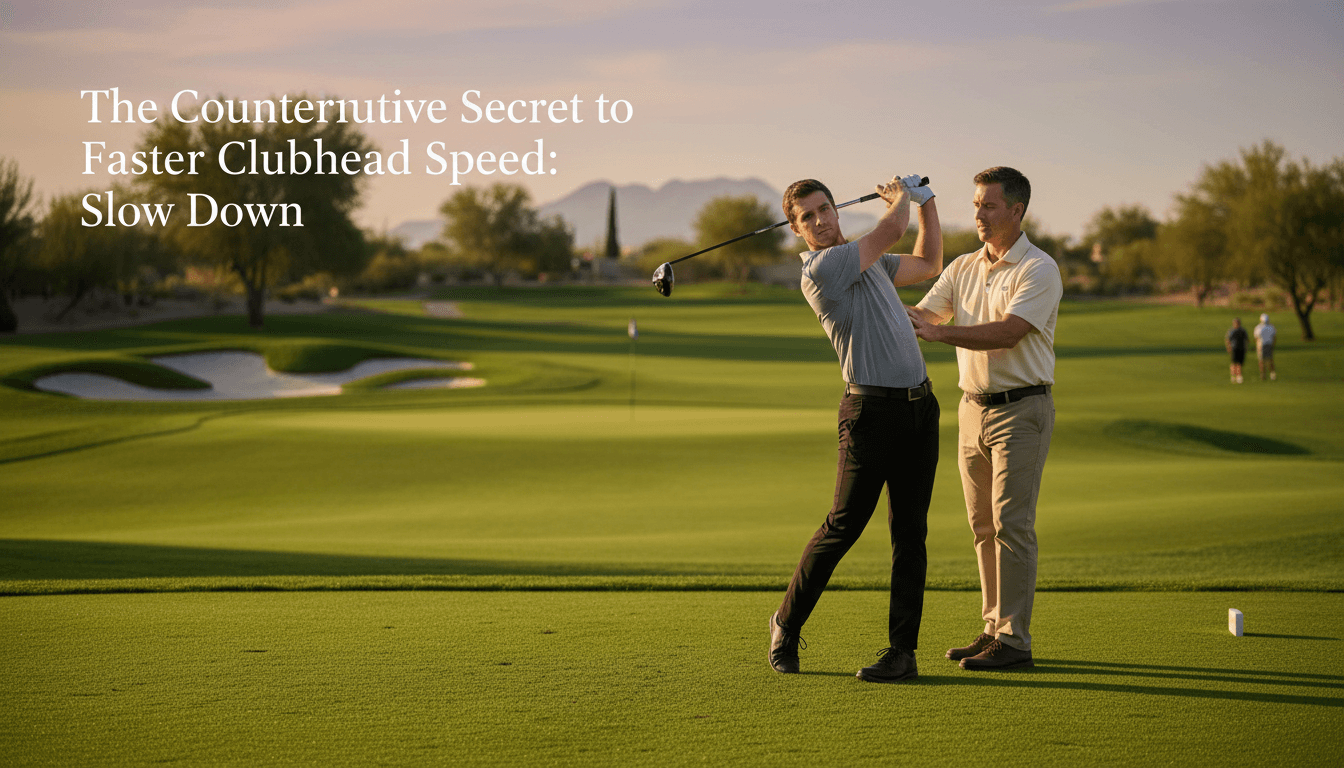
There's a particular kind of frustration that lives in the bones of every golfer who's ever taken a lesson, felt the epiphany on the range, and then watched it evaporate somewhere between the parking lot and the first tee. I've been there myself—standing over a ball in Scotland, certain I'd finally figured out my transition, only to blade a 7-iron into a gorse bush that seemed personally offended by my presence.
So when GOLF Top 100 Teacher Tony Ruggiero talks about why swing changes don't stick, I lean in. His recent explanation of slow-speed movement work isn't just instruction—it's a philosophy that challenges everything we think we know about practice.
Why Your Brain Won't Let You Change at Full Speed
Here's the uncomfortable truth Ruggiero illuminates: when you're swinging at full speed, you're in performance mode, not learning mode. Your nervous system is running on autopilot, executing the patterns it already knows, regardless of how many times your instructor has told you to "feel the hip turn."
Think of your golf swing as a well-worn path through tall grass. You've walked it thousands of times. Trying to forge a new path while sprinting isn't just difficult—it's neurologically impossible. Your body will default to the familiar route every single time.
Ruggiero's approach strips away the ball entirely. No target, no result to judge, no performance anxiety hijacking your motor learning. Just slow, deliberate movement where your brain can actually process new information.
The Case Study: Lisa's Three-Month Backswing Journey
Ruggiero's work with a student named Lisa illustrates this beautifully. She came in searching for lost speed, but her swing was sabotaging itself before she ever reached the top. A hip slide away from the ball created a reverse pivot-chicken wing combination that plagues countless weekend players.
Rather than throw a dozen swing thoughts at her, Ruggiero prescribed just two drills. In the first, Lisa made slow backswing turns while stretching an exercise band away from her torso, coiling into her right hip rather than sliding. The resistance completely changed her feel for the movement.
The second drill had her cross her arms over her chest, pull her lead foot back into a split stance, and make slow backswings. The altered stance essentially forced the correct pivot—there was no other option.
Here's where most golfers go wrong: Lisa didn't do these drills for twenty minutes and consider herself fixed. She stayed on these two movements—just the backswing—for three months.
The Patience Most Golfers Won't Give
Three months on the backswing alone. Let that sink in. In a culture of quick fixes and YouTube miracle cures, that kind of patience feels almost radical. Ruggiero emphasizes that results will be uneven in the short term—some days feeling breakthrough, others feeling like regression. The key is staying focused on one fundamental over time.
The payoff? Lisa developed a better backswing, which naturally improved her top position and transition. Working with fellow instructor Morgan Hale, they added exercises to improve her sequence and rotation through impact. The dreaded chicken wing began to disappear. She found more compression, more consistency, and—yes—the speed she'd originally come searching for.
What This Means for Your Practice
I've played courses where time seemed to stop—Ballyneal at sunset, the linksland of Machrihanish, morning frost burning off at Sand Valley. But I've never felt time stretch quite like it does during slow-motion swing work. It's uncomfortable. It's boring. It feels like you're not actually doing anything.
That discomfort is precisely the point. Real change lives in the space between what feels natural and what feels foreign.
If you're serious about changing your swing, consider this: find one movement that needs work, find a drill that emphasizes it without a ball, and commit to slow, deliberate repetitions for far longer than feels reasonable. Not a week. Not a month. Give it a full season.
The Takeaway
Slow-motion practice without a ball isn't wasted time—it's the only way lasting swing changes actually take root. Your brain needs time and deliberate movement to forge new patterns. Rushing back to full-speed swings before those patterns are ingrained is why lessons don't stick. The fastest path to more speed, ironically, runs right through the slowest work you'll ever do.